Stop Questioning Yourself: A Guide for Leaders
Start Backing Yourself In The Workplace
Stop Questioning Yourself: A Guide for Leaders
I recently worked with a senior manager in a large construction company who, from the outside, was doing really well. She has a successful career, a lot of responsibility and was highly regarded by the people around her. But there was a problem. She wasn’t sleeping properly.
She’d get into bed at night and her brain would decide it was the perfect time to go back over the entire working day.
Did I handle that meeting properly?
Should I have said something different?
Was that the right decision?
What if I’ve missed something?
Decisions she’d made at 2pm were still being discussed at midnight. Unfortunately, by then, the meeting only had one person in it. Her.
What became clear as we worked together was that she wasn’t struggling to make decisions. She was struggling to trust herself once she’d made them.
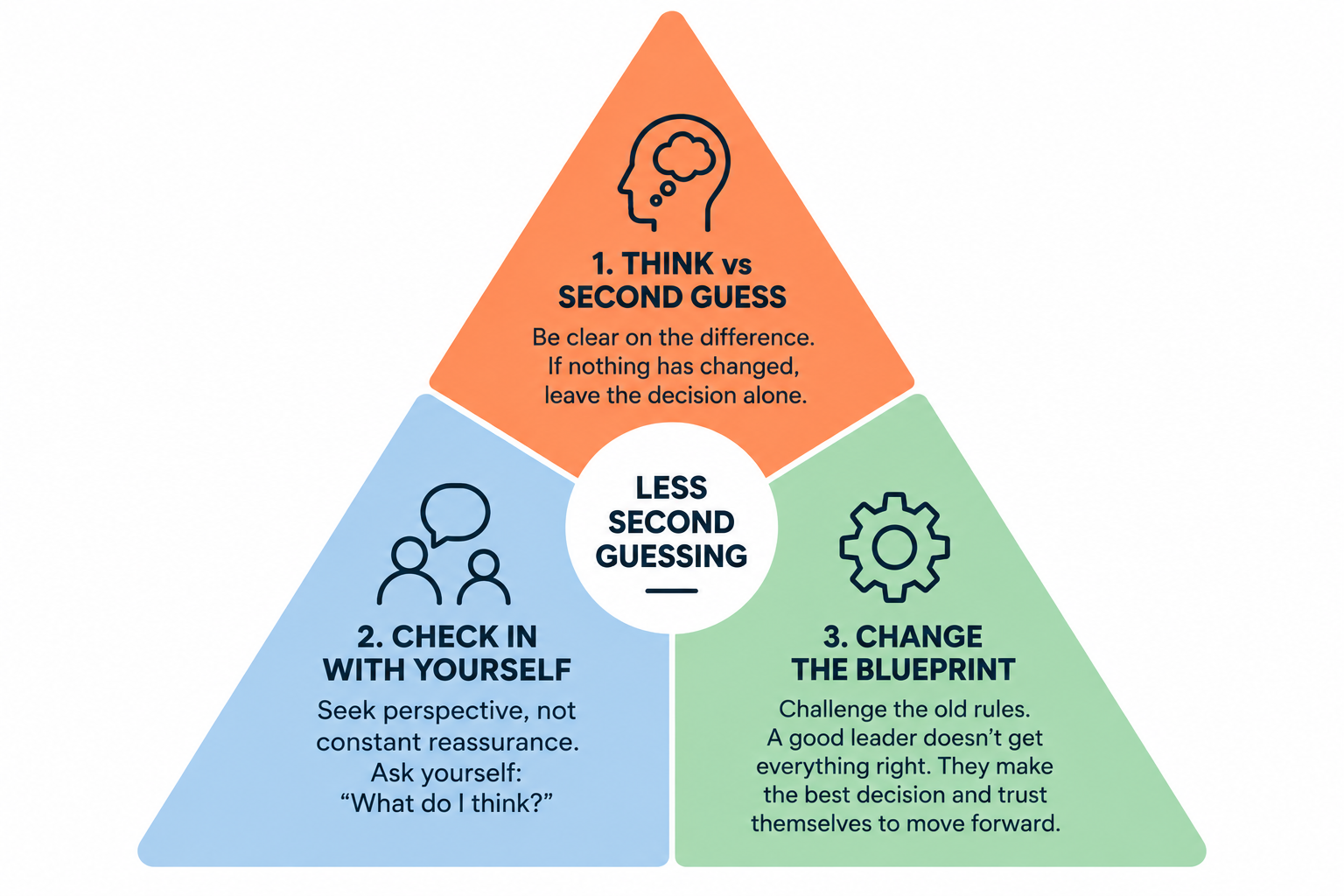
So we worked on three things.
The first was learning the difference between thinking something through and second guessing herself. Thinking is useful. If you’ve got new information or something has genuinely changed, of course you should reconsider a decision. Second guessing is different. It’s going over the same information again and again, hoping you’ll eventually reach a point where you feel completely certain.
I gave her a simple question to ask herself: “Has anything actually changed?” If nothing had changed, she practised leaving the decision alone and getting on with her day.
The second thing we worked on was reassurance. She’d often ask other people what they thought, which of course isn’t a bad thing. Good leaders want different perspectives. But sometimes she wasn’t really asking for perspective. She was looking for someone to tell her, “Yes, you’ve made the right decision.” There’s some interesting psychology behind this. Reassurance can make us feel better in the short term, but if we continually rely on it, we can get into the habit of looking outside ourselves whenever uncertainty appears.
So before asking anyone else, she started asking herself: “What do I think?”
The third part was probably the most important. We looked at her Blueprint.
Underneath the second guessing were some pretty tough rules about what she thought being a good leader meant. I should know the answer. I shouldn’t get things wrong. People expect me to get this right. We started challenging those beliefs.
Being a good leader doesn’t mean getting every decision right. It means making the best decision you can with what you know at the time and trusting yourself to deal with whatever happens next.
As her Blueprint began to change, so did she. She questioned herself less, trusted her judgement more and, importantly, started sleeping better.
That’s why simply telling someone to “stop overthinking” isn’t particularly helpful. Sometimes the overthinking is just what you can see on the surface.
The more interesting question is: What’s in your Blueprint that makes all this second guessing feel necessary?
It's like looking under the hood of a car, and looking at the engine driving the entire vehicle. When we have a look instead of taking a guess as to why we overthink at times, we can get to the root of the problem almost immediately and start changing who we are.
If you’re a leader who makes decisions all day and then takes them home with you at night, then feel free to message me.
Sometimes understanding why you’re questioning yourself so much is the best place to start.